
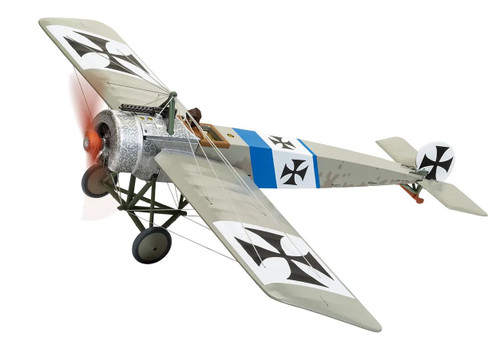
Corgi 1/48 Fokker E.III Eindecker, Vfw. Ernst Udet - Germany March 1916
- SKU:
- COR AA28703
- Brand:
- Corgi
Fokker E.III Eindecker, 105/15, Vfw. Ernst Udet, Germany, March 1916.
As the savage fighting on the Western Front revealed its insatiable appetite for consuming the lives of young men from all nationalities, a new war being waged in the skies above was about to take a similarly sinister turn. With their understanding of the absolute necessity to gain a control of the air and the wider implications this would have for the future of the entire conflict, the German High Command instructed its aircraft manufacturers to develop a new kind of aeroplane, one which was intended to hunt other aeroplanes and claim superiority of the skies.
The result of that search was the Fokker Eindecker, a mono wing fighter aircraft which represented the very pinnacle of aviation technology at that time, incorporating all the flight research data designers had managed to amass and utilising all the very latest technological advances in aviation. With the ability to fire its machine gun through the arc of the propeller by using a clever interrupter gear mechanism, all the pilot of an Eindecker had to do was to aim the nose of his aircraft in the direction of his target and fire, something of a revolutionary concept in aviation, but one which wasn't as simple as this description suggests.
It has to be remembered that the aeroplane was still in its relative infancy at that time and even though it was a technological marvel, the Eindecker was still rather primitive and relatively underpowered, making their pilots true pioneers in their craft. If they were competent enough to manoeuvre their aircraft into an attack position behind an enemy aircraft, the rudimentary wing warping flight control method could soon have them in trouble. If they let the thrill of combat overtake their judgement, a tight turn to stay on the tail of their intended victim could see them entering a dangerous spin, at best losing valuable altitude and the chance of gaining a victory and at worst, not stopping until the aircraft hit the ground.
Early Eindecker pilots were effectively writing the rules of aerial combat as they attempted to control the skies and with each hunting unit only usually being allocated three or four of the new fighters, they were still quite an exclusive group of airmen. Armed with their capable new aircraft, they learned quickly and Allied aircrews soon began to feel like they were nothing more than airborne prey.
With its position as the first true fighter aircraft in the world, the Eindecker is widely regarded by historians as the most influential military aircraft in the history of flight and even though the period referred to by the Allies as the 'Fokker Scourge' only lasted for a relatively short period of the war, the Eindecker had already made its significant contribution to aviation history. Relegated to non-combat and reserve roles by 1917, the Fokker Eindecker would also be used by the first fighter pilots of the Austro-Hungarian and Turkish air forces during the Great War.
Growing up in Munich, a young Ernst Udet was fascinated by the subject of aviation from an early age and would spend much of his free time doing whatever jobs he could at the local aircraft manufacturing company, whilst also helping to establish the Munich Aero-club. He was finally able to make his first powered flight with a test pilot from the aerodrome where he used to help out, but not before he had almost killed himself attempting to fly a glider he and his friends had built themselves.
Following the start of WWI, Udet applied to join the German Army, but standing just 5ft 3 ins tall was told that he didn't qualify. He would later use his motorcycle riding skills to gain a position in a military dispatch riding unit, but following an accident where he was thrown from the motorcycle as it ran over a shell crater, required a period of extensive recouperation.
During his return to health, Udet befriended some men who were assigned to a flying unit and convinced him to apply for pilot training, but after a couple of disappointments, discovered that the only way to guarantee acceptance in the Imperial German Air Service was to hold a civilian pilots licence. Immediately returning home and to the aerodrome where he had spent so many happy hours, a test pilot there agreed to teach him, but at his own expense and on receipt of his licence was finally successful with his application to join the Air Force. His initial posting was as pilot in a reconnaissance squadron, flying spotting and artillery ranging missions with his assigned observer and to say his service introduction was eventful would be something of an understatement.
He would be awarded the Iron Cross 2nd class for flying his damaged aircraft back to his home airfield following the failure of a wing brace anchor and with his observer on the wing, holding the wing together, but was later placed under arrest for recklessly overloading his aircraft with fuel and bombs when attempting to attack the enemy. When asked to observe an early bombing mission on his return to duty, where bombs were simply thrown from the cockpit of attacking aircraft, Udet impressed his commander by basically flying aerobatics in one of these primitive military aircraft, in an attempt to dislodge a bomb stuck in the undercarriage of his aircraft. On landing, he was immediately recommended for retraining as a fighter pilot.
Udet's introduction as a fighter pilot proved to be just as eventful as his reconnaissance posting. Flying a Fokker Eindecker, he chose to ignore combat instructions and attack a French aircraft head on and as the two aircraft closed at speed, Udet inexplicably froze. The French airman did not miss his opportunity and fired on the German aircraft, with a bullet grazing Udet's cheek and shattering his flying goggles, but failing to score a decisive victory.
Udet escaped this encounter relatively unscathed, but resolved to never give his opponent such a chance again and to always fly decisively and aggressively when in combat, perfecting his fighting style and to become an ace airman at the earliest opportunity. It is thought that Udet may have scored his first aerial victory whilst flying Fokker Eindecker E.III 105/15 in March 1916, the aircraft we have modelled here and on landing, he was immediately promoted to the rank of Vizefeldwebel.
Ernst Udet would quickly demonstrate his flying prowess and made good on the promise he made to himself. With his victory tally standing at 20, he was visited by a rather famous flying celebrity, a man who wanted him to join his celebrated Flying Circus, and when you are approached by a man such as Manfred von Richthofen, you definitely don't decline such an opportunity.
Having witnessed Udet shooting down an Allied artillery spotter during their first combat sortie, interestingly by performing a frontal attack similar to the one where he was almost killed, von Richthofen immediately gave his new recruit command of his old squadron, Jasta 11 and he would not regret the faith he showed in him. Udet would end the war with 62 confirmed victories, the most successful Great War air ace to survive the conflict and second only in number to the great von Richthofen himself.
What's In The Box?
- 1 x DieCast Model Aircraft
Technical Specifications:
Item Length - Without Packaging (cm): 14.9
Item Height - Without Packaging (cm): 5.4
Item Width - Without Packaging (cm): 20.8
Item Scale: 1:48 Scale
Finish: Painted
Colour: Multi
Wingspan (mm): 208
Detailed Crew Figures: Yes
Fine Rigging Detail: Yes
Fixed Undercarriage: Yes
Rotatable Propeller(s)/Rotor(s): Yes
Wood Grain Effect Propeller: Yes
Shipping
$13.50 Flat Rate - Nationwide!
Saturday Delivery
Unfortunately Saturday delivery is no longer available at RC Hobbies.
Delivery
Once RC Hobbies has confirmed acceptance of the buyer's order, we will endeavor to dispatch the buyer's order within
1-3 Business days unless a different time frame is specified in relation to a particular product. If we are unable to dispatch
the buyer's order within the time frame specified by RC Hobbies we will endeavor to contact the buyer and advise
the buyer of the expected dispatch date.
In stock items are generally dispatched on the same day you place your order, unless a different time frame is specified
in relation to a particular product and provided the order was placed before our daily cut off time which is usually
around 1PM.
We use NZ Post, Aramex, and Post Haste for New Zealand orders. Deliveries are usually 2 working days, but please allow an extra
day for big parcels to reach the South Island and for rural deliveries.
We use NZ Post for orders that can fit into overnight courier bags and Post Haste for larger parcels.
Tracking emails will be sent out once parcels have been collected.
The buyer may specify delivery instructions for an order (for example, the buyer may authorise the delivery agent to
leave the products in a specified location if the buyer will not be at the delivery address). RC Hobbies will
not be responsible for any order that is delivered in accordance with the buyer’s delivery instructions.
Delivery to PO Boxes
RC Hobbies can send goods to PO Boxes, except for large freight boxes.
International Delivery.
We're based in New Zealand but we deliver all round the world. Please use our shipping estimator at checkoutfor a shipping quote or contact us and will send you
a quote.
sales@rchobbies.co.nz
Returns Policy
The item I received is not the item I ordered
Provided the item is unopened and in mint condition we’ll replace the item. To receive your replacement you must return the
original item to. You will be provided with a no-cost return addressed courier satchel (or similar)
and we will process your replacement within 1–3 days of receiving your item.
The item I ordered arrived faulty.
Please arrange with RC Hobbies to return the item for testing. If we confirm that the item was damaged before leaving
RC Hobbies, or was faulty out of the box, your item will be repaired or if it cannot be repaired then it will be replaced
by RC Hobbies Ltd free of charge. If the goods are faulty we will meet our obligations under the Consumers Guarantees
Act to provide a remedy.
The item I ordered did not arrive
If your item did not arrive the first thing to do is request a “track and trace” on your item from the Courier Post or Fastway
tracking emails we send out.
Alternatively you can call Courier Post on
0800 268 743 or Post Haste on
09 444 2950
If the “track and trace” on your order indicates that it has been delivered, but you’re unable to find it or it hasn’t been
delivered within the timeframe we will start an investigation with Courier Post & Post Haste on your behalf.
Regrettably, neither RC Hobbies nor Courier Post & Fastway are able to refund or replace items that have been lost, damaged
or stolen after being delivered to your property. If you are concerned about leaving your items unattended we recommend
using “Signature Required” option which is our default option unless advise by the Buyer to use the “No Signature Required”
option.
I've changed my mind and no longer want the item I ordered
Change of mind returns can be processed as long as it has been agreed by RC Hobbies and the item has been returned
within 7 days of dispatch and is unopened and in mint condition. The shipping for the return will also be at the cost
of the buyer. Once we have the item in hand we will assess the item and if everything checks out OK you will receive
a Store Credit or refund less the restock fee and freight charges.
Restock fee
All goods ordered in error by the Customer or goods the Customer wishes to return are subject to a restock fee. The fee is
15% of the goods sales value. This applies if you change your mind, ordered it in error, unwanted Gift or just did not
like it or did not suit you, so please choose carefully and read the descriptions in the listings as some products also
require additional items to complete.
Description
Fokker E.III Eindecker, 105/15, Vfw. Ernst Udet, Germany, March 1916.
As the savage fighting on the Western Front revealed its insatiable appetite for consuming the lives of young men from all nationalities, a new war being waged in the skies above was about to take a similarly sinister turn. With their understanding of the absolute necessity to gain a control of the air and the wider implications this would have for the future of the entire conflict, the German High Command instructed its aircraft manufacturers to develop a new kind of aeroplane, one which was intended to hunt other aeroplanes and claim superiority of the skies.
The result of that search was the Fokker Eindecker, a mono wing fighter aircraft which represented the very pinnacle of aviation technology at that time, incorporating all the flight research data designers had managed to amass and utilising all the very latest technological advances in aviation. With the ability to fire its machine gun through the arc of the propeller by using a clever interrupter gear mechanism, all the pilot of an Eindecker had to do was to aim the nose of his aircraft in the direction of his target and fire, something of a revolutionary concept in aviation, but one which wasn't as simple as this description suggests.
It has to be remembered that the aeroplane was still in its relative infancy at that time and even though it was a technological marvel, the Eindecker was still rather primitive and relatively underpowered, making their pilots true pioneers in their craft. If they were competent enough to manoeuvre their aircraft into an attack position behind an enemy aircraft, the rudimentary wing warping flight control method could soon have them in trouble. If they let the thrill of combat overtake their judgement, a tight turn to stay on the tail of their intended victim could see them entering a dangerous spin, at best losing valuable altitude and the chance of gaining a victory and at worst, not stopping until the aircraft hit the ground.
Early Eindecker pilots were effectively writing the rules of aerial combat as they attempted to control the skies and with each hunting unit only usually being allocated three or four of the new fighters, they were still quite an exclusive group of airmen. Armed with their capable new aircraft, they learned quickly and Allied aircrews soon began to feel like they were nothing more than airborne prey.
With its position as the first true fighter aircraft in the world, the Eindecker is widely regarded by historians as the most influential military aircraft in the history of flight and even though the period referred to by the Allies as the 'Fokker Scourge' only lasted for a relatively short period of the war, the Eindecker had already made its significant contribution to aviation history. Relegated to non-combat and reserve roles by 1917, the Fokker Eindecker would also be used by the first fighter pilots of the Austro-Hungarian and Turkish air forces during the Great War.
Growing up in Munich, a young Ernst Udet was fascinated by the subject of aviation from an early age and would spend much of his free time doing whatever jobs he could at the local aircraft manufacturing company, whilst also helping to establish the Munich Aero-club. He was finally able to make his first powered flight with a test pilot from the aerodrome where he used to help out, but not before he had almost killed himself attempting to fly a glider he and his friends had built themselves.
Following the start of WWI, Udet applied to join the German Army, but standing just 5ft 3 ins tall was told that he didn't qualify. He would later use his motorcycle riding skills to gain a position in a military dispatch riding unit, but following an accident where he was thrown from the motorcycle as it ran over a shell crater, required a period of extensive recouperation.
During his return to health, Udet befriended some men who were assigned to a flying unit and convinced him to apply for pilot training, but after a couple of disappointments, discovered that the only way to guarantee acceptance in the Imperial German Air Service was to hold a civilian pilots licence. Immediately returning home and to the aerodrome where he had spent so many happy hours, a test pilot there agreed to teach him, but at his own expense and on receipt of his licence was finally successful with his application to join the Air Force. His initial posting was as pilot in a reconnaissance squadron, flying spotting and artillery ranging missions with his assigned observer and to say his service introduction was eventful would be something of an understatement.
He would be awarded the Iron Cross 2nd class for flying his damaged aircraft back to his home airfield following the failure of a wing brace anchor and with his observer on the wing, holding the wing together, but was later placed under arrest for recklessly overloading his aircraft with fuel and bombs when attempting to attack the enemy. When asked to observe an early bombing mission on his return to duty, where bombs were simply thrown from the cockpit of attacking aircraft, Udet impressed his commander by basically flying aerobatics in one of these primitive military aircraft, in an attempt to dislodge a bomb stuck in the undercarriage of his aircraft. On landing, he was immediately recommended for retraining as a fighter pilot.
Udet's introduction as a fighter pilot proved to be just as eventful as his reconnaissance posting. Flying a Fokker Eindecker, he chose to ignore combat instructions and attack a French aircraft head on and as the two aircraft closed at speed, Udet inexplicably froze. The French airman did not miss his opportunity and fired on the German aircraft, with a bullet grazing Udet's cheek and shattering his flying goggles, but failing to score a decisive victory.
Udet escaped this encounter relatively unscathed, but resolved to never give his opponent such a chance again and to always fly decisively and aggressively when in combat, perfecting his fighting style and to become an ace airman at the earliest opportunity. It is thought that Udet may have scored his first aerial victory whilst flying Fokker Eindecker E.III 105/15 in March 1916, the aircraft we have modelled here and on landing, he was immediately promoted to the rank of Vizefeldwebel.
Ernst Udet would quickly demonstrate his flying prowess and made good on the promise he made to himself. With his victory tally standing at 20, he was visited by a rather famous flying celebrity, a man who wanted him to join his celebrated Flying Circus, and when you are approached by a man such as Manfred von Richthofen, you definitely don't decline such an opportunity.
Having witnessed Udet shooting down an Allied artillery spotter during their first combat sortie, interestingly by performing a frontal attack similar to the one where he was almost killed, von Richthofen immediately gave his new recruit command of his old squadron, Jasta 11 and he would not regret the faith he showed in him. Udet would end the war with 62 confirmed victories, the most successful Great War air ace to survive the conflict and second only in number to the great von Richthofen himself.
What's In The Box?
- 1 x DieCast Model Aircraft
Technical Specifications:
Item Length - Without Packaging (cm): 14.9
Item Height - Without Packaging (cm): 5.4
Item Width - Without Packaging (cm): 20.8
Item Scale: 1:48 Scale
Finish: Painted
Colour: Multi
Wingspan (mm): 208
Detailed Crew Figures: Yes
Fine Rigging Detail: Yes
Fixed Undercarriage: Yes
Rotatable Propeller(s)/Rotor(s): Yes
Wood Grain Effect Propeller: Yes
Videos
0 Reviews
Shipping & Returns
Shipping
$13.50 Flat Rate -Nationwide!
Delivery
Once E&E TRADERS LTD has confirmed acceptance of the buyer's order, we will endeavor to dispatch the buyer's order within
24 Hours unless a different time frame is specified in relation to a particular product. If we are unable to dispatch
the buyer's order within the time frame specified by E&E TRADERS LTD we will endeavor to contact the buyer and advise
the buyer of the expected dispatch date.
In stock items are generally dispatched on the following business day, unless a different time frame is specified
in relation to a particular product and provided the order was placed before our daily cut off time which is usually
around 1PM - 2PM.
We use Courier Post and Fastway for New Zealand orders. Deliveries are usually overnight, but please allow an extra
day for big parcels to reach the South Island and for rural deliveries.
We use Courier Post for orders that can fit into overnight courier bags and Fastway for larger parcels.
Tracking emails will be sent out once parcels have been collected.
The buyer may specify delivery instructions for an order (for example, the buyer may authorise the delivery agent to
leave the products in a specified location if the buyer will not be at the delivery address). RC Hobbies 12 Ltd will
not be responsible for any order that is delivered in accordance with the buyer’s delivery instructions.
Delivery to PO Boxes
E & E TRADERS LTD can send goods to PO Boxes
International Delivery.
We're based in New Zealand but we deliver all round the world. Please contact us for a shipping quote or we will send you
a quote after your order has been placed.
sales@rchobbies.co.nz
Returns Policy
The item I received is not the item I ordered
Provided the item is unopened and in mint condition we’ll replace the item. To receive your replacement you must return the
original item to E & E TRADERS LTD. You will be provided with a no-cost return addressed courier satchel (or similar) and
we will process your replacement within 1–3 days of receiving your item.
The item I ordered arrived faulty.
Please arrange with E & E TRADERS LTD to return the item for testing. If we confirm that the item was damaged before leaving
RC Hobbies, or was faulty out of the box, your item will be repaired or if it cannot be repaired then it will be replaced
by E & E TRADERS LTD free of charge. If the goods are faulty we will meet our obligations under the Consumers Guarantees
Act to provide a remedy.
The item I ordered did not arrive
If your item did not arrive the first thing to do is request a “track and trace” on your item from the Courier Post or Fastway tracking emails we send out.
Alternatively you can call Courier Post on 0800 268 743 or Fastway on 09 634 3704
If the “track and trace” on your order indicates that it has been delivered, but you’re unable to find it or it hasn’t been
delivered within the timeframe we will start an investigation with Courier Post & PostHaste on your behalf.
Regrettably, neither RC Hobbies nor Courier Post & PostHaste are able to refund or replace items that have been lost, damaged or stolen
after being delivered to your property. If you are concerned about leaving your items unattended we recommend using “Signature
Required” option which is our default option unless advise by the Buyer to use the “No Signature Required” option.
I've changed my mind and no longer want the item I ordered
Change of mind returns can be processed as long as it has been agreed by E & E TRADERS LTD and the item has been returned
within 7 days of dispatch and is unopened and in mint condition. The shipping for the return will also be at the cost of
the buyer. Once we have the item in hand we will assess the item and if everything checks out OK you will receive a Store
Credit or refund less the restock fee and freight charges.
Restock fee
All goods ordered in error by the Customer or goods the Customer wishes to return are subject to a restock fee. The fee is
10% of the goods sales value. This applies if you change your mind, ordered it in error, unwanted Gift or just did not like
it or did not suit you, so please choose carefully and read the descriptions in the listings as some products also require
additional items to complete.
Related Products
Corgi 1/48 Fokker DR1 Triplane Ltn Hans Weiss
COR AA38312Fokker Dr.1545/17, Ltn Hans Weiss, Jasta 11, Jagdgeschwader 1, Cappy Aerodrome, France, 21st April 1918 - Last combat sortie of the Red BaronAt 10am on 21st April 1918, six Fokker Dr.1 fighter...

Corgi 1/72 Messerschmitt Bf109 E-4 - NJG 1 Germany 1940
COR AA28008This distinctive Messerschmitt Bf 109E fighter from Nachtjagdgeschwader 1 was equipped with a Telefunken designed Peil Gerat IV electronic radio direction finder unit, one of the first airborne...
Corgi 1/48 Bristol F2B Fighter 'Charlie Chaplin'
COR AA28802Great War Australian ace pilot Captain Sydney Dalrymple transferred to the newly formed No.139 Squadron at Villaverla in Italy during the summer of 1918, where he would be flying the Bristol Fighter...

Corgi 1/48 SE5a Biplane RAF No 74Sqn - Maj. Keith Logan Caldwell
COR AA37711SE5a, Maj. Keith Logan Caldwell, RAF No 74Sqn, Clairmarais, France, September 1918Already celebrated as a brave and tenacious pilot, New Zealander Keith Caldwell would surpass his own high standards...